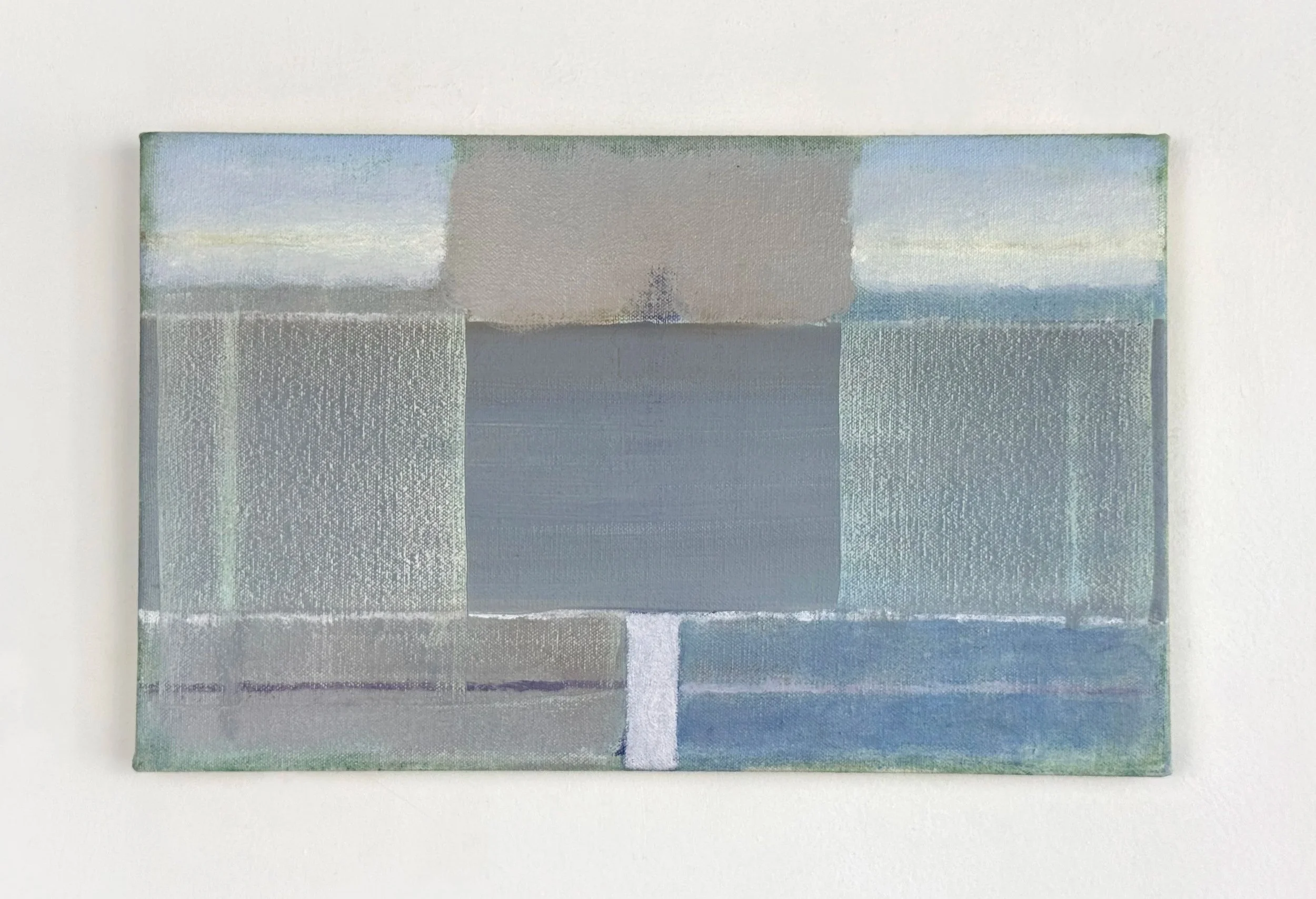
Erin Hunt, Scleranthus, 2025, oil and chalk pastel on canvas, scleranthus flower essence, 10 x 16 x 0.8 inches. Courtesy of the artist.
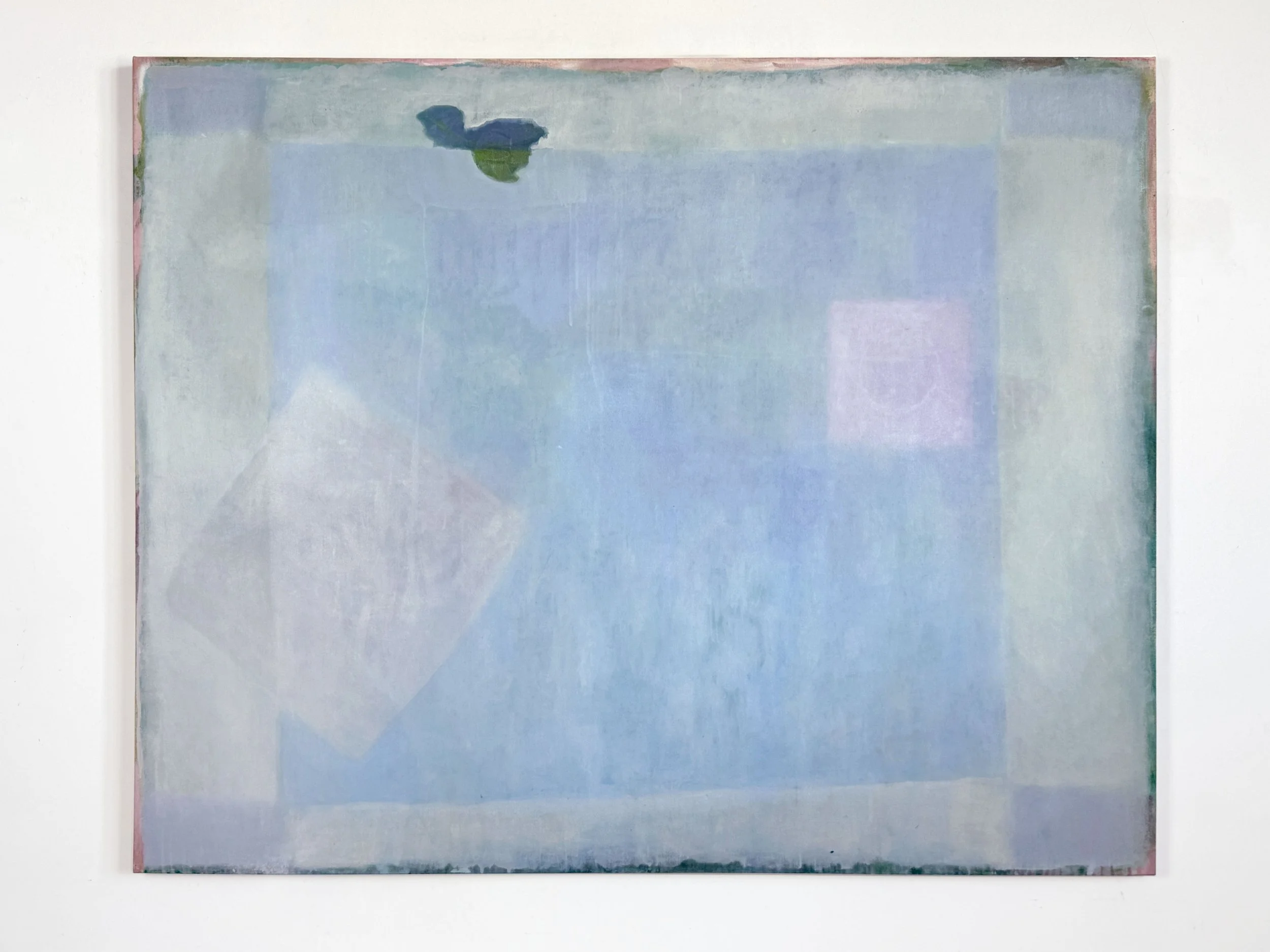
Erin Hunt, Pearly Everlasting, 2023-2025, oil and chalk pastel on canvas, Rose Quartz and Pearly Everlasting flower essence, 48 x 60 x 1.5 inches. Courtesy of the artist.
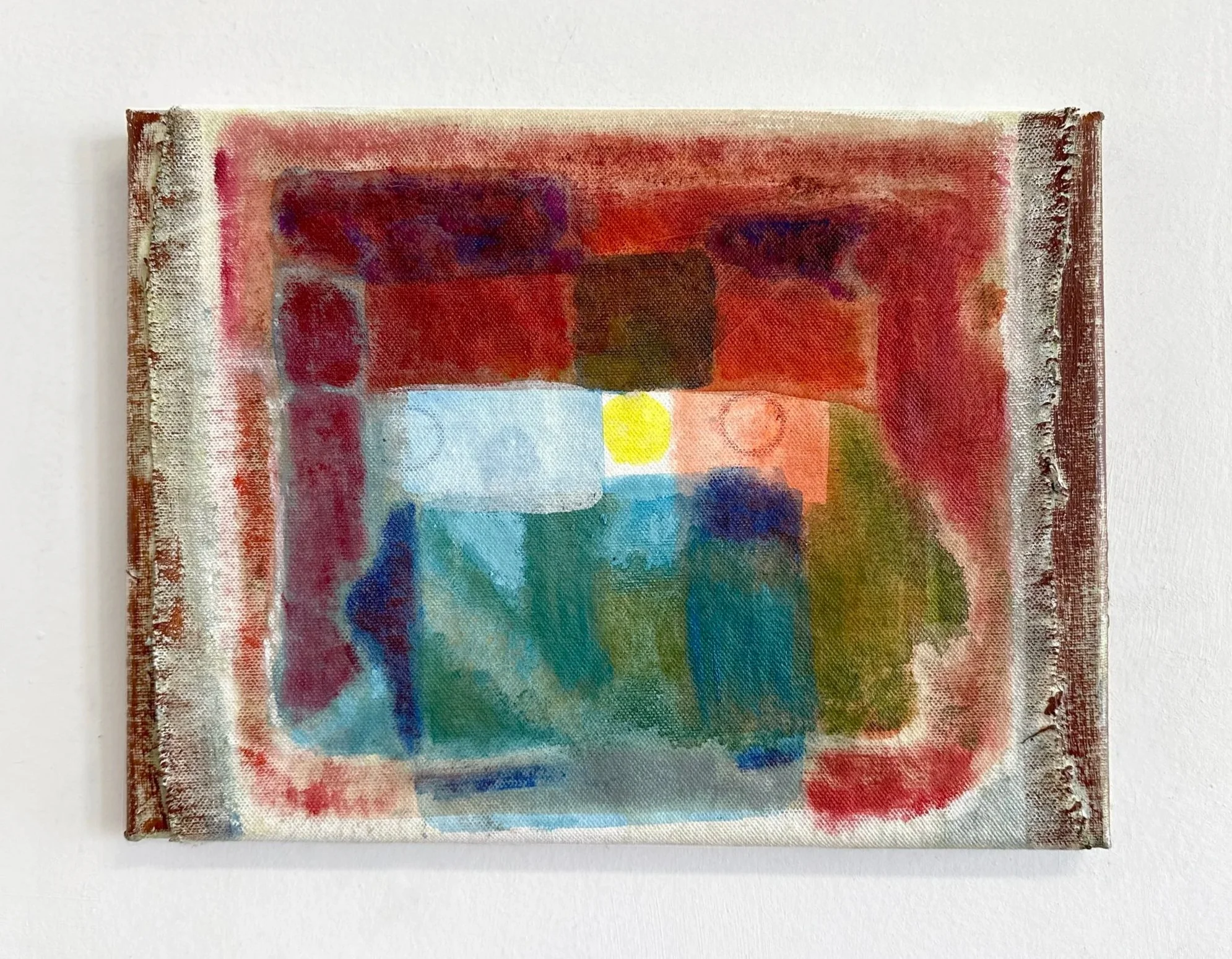
Erin Hunt, Artificial Artifacts, 2023, oil, ink, coloured pencil on canvas on canvas. Courtesy of the artist.
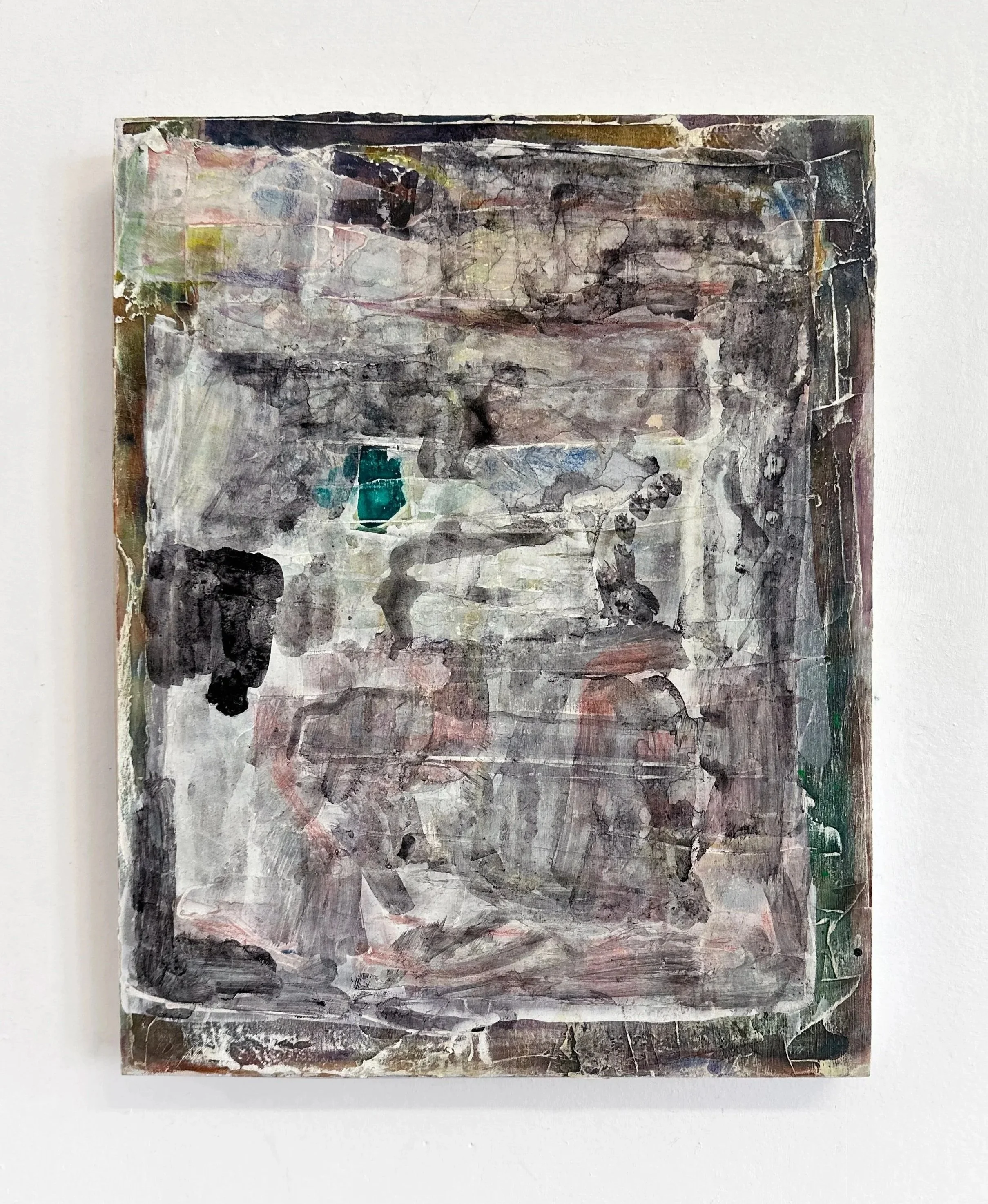
Erin Hunt, Look for the problem that's been there all along, 2023, oil, ink, watercolour, graphite on wood, 14 x 11 x 0.7 inches. Courtesy of the artist.
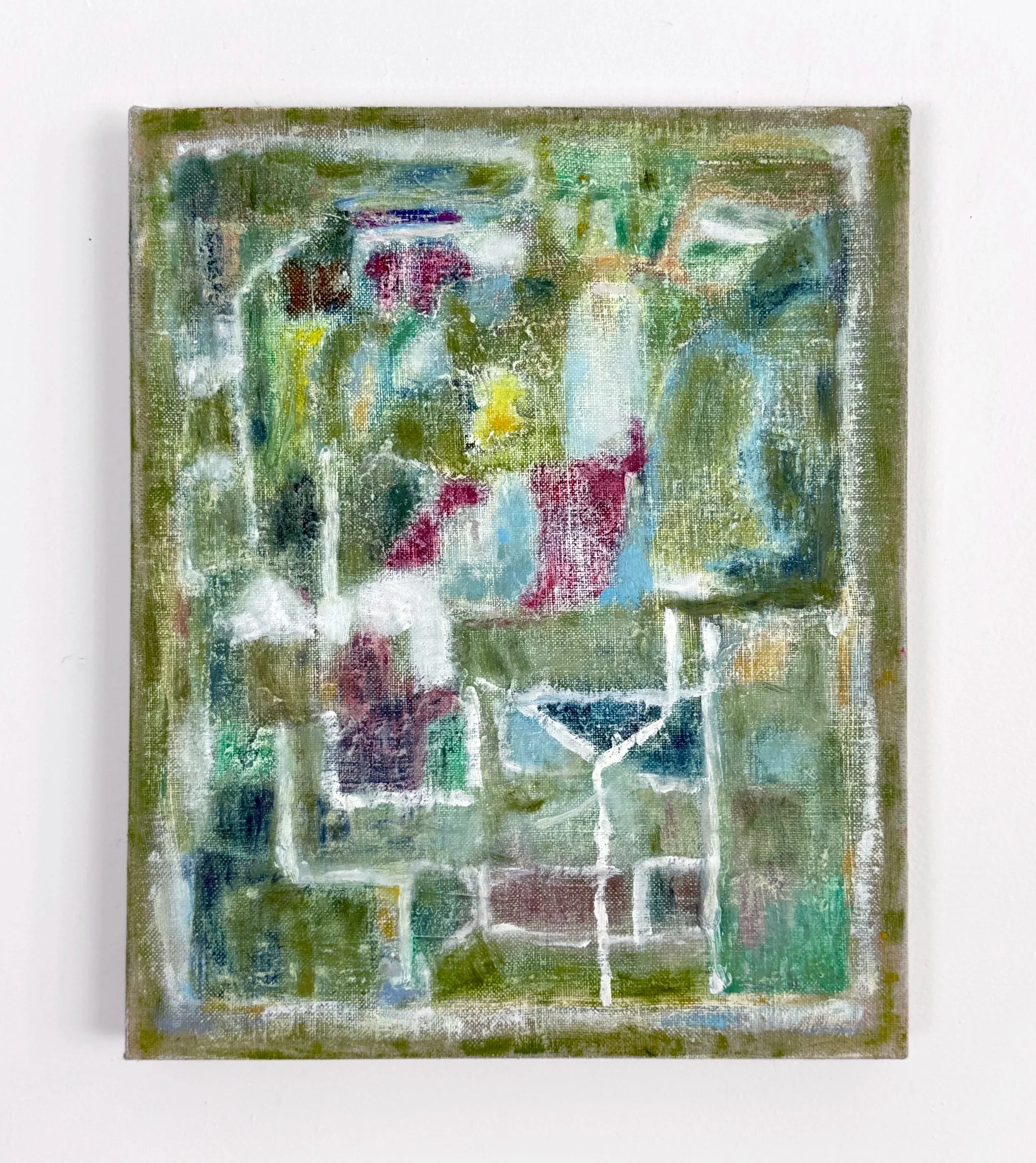
Erin Hunt, Winter's Nap, 2023, oil, watercolour, wax on linen, 17 x 14 x 1.5 inches. Courtesy of the artist.
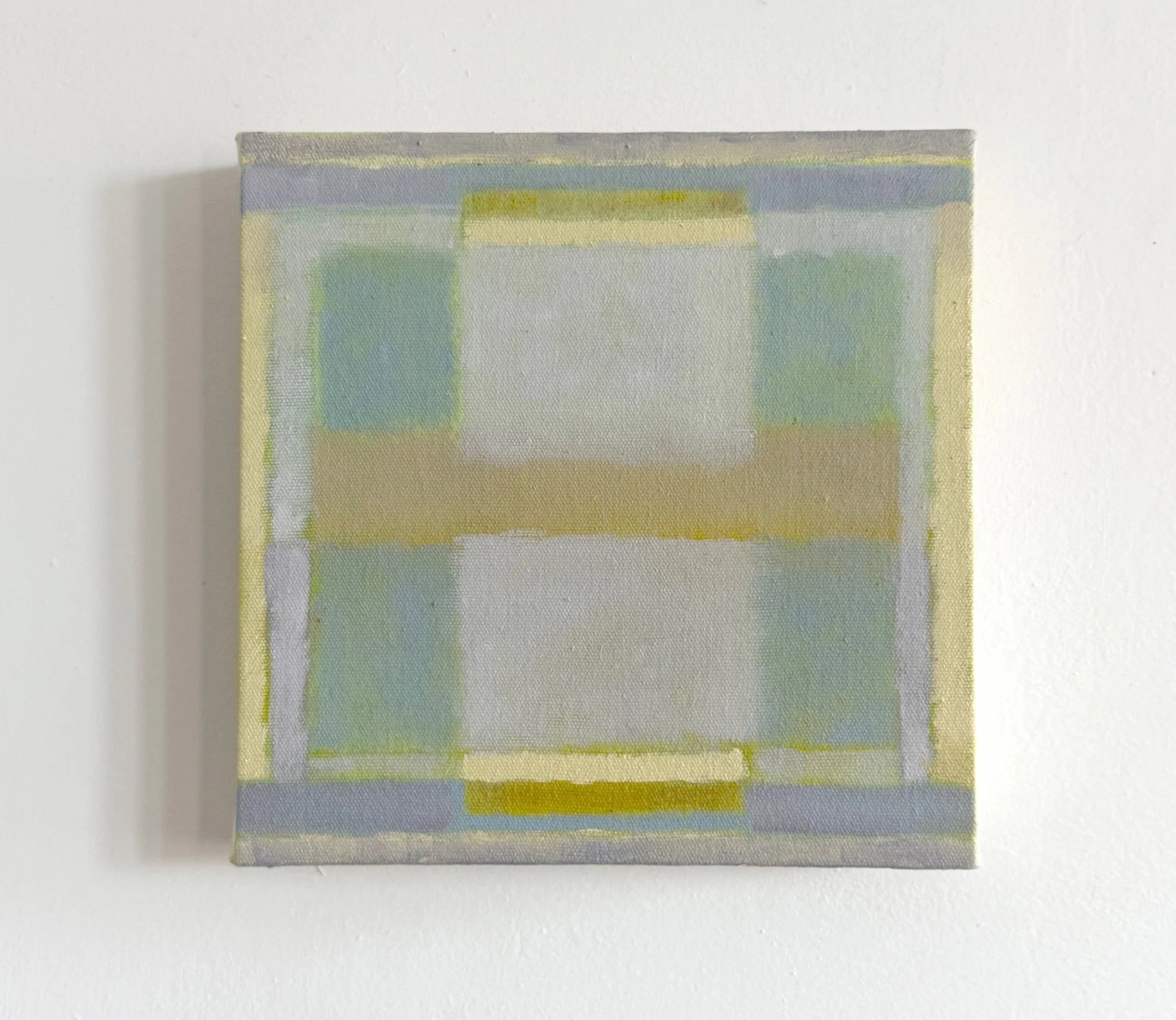
Erin Hunt, Bakeapple, 2025, oil, coloured pencil, chalk pastel on canvas, Bakeapple flower essence, 10 x 10 inches. Courtesy of the artist.
Time has a particular quality in Erin Hunt’s studio. Natural light moves softly around the room, and the scent of oil paint hangs in the air, charged particles drifting over paintings in various states and over the things that inform them: objects found on beaches, rocks, plants, old photographs, drawings, books of poetry, art history, and philosophy. I’ve returned to this place—this cluster of rooms on the top floor of the old courthouse in Fogo—several times over the past three years, but my memories of the visits blur together. Paintings circulate from easel to wall to floor to stack, facing the artist or the wall or each other as they move through different states.
Walls and tables hold small constellations of material, arranged like visual poems. The paintings, the arrangements, and the seasons change, yet something in the nature of Hunt’s work, and in the space she creates for it, moves outside of hours and days. There is deep time—coded in the molecules and cells that become physical and biological forms, in painterly substances, flowers, and retinas alike. And there is the malleability of time in how we synthesize it: the ways our minds and bodies accumulate and process it through memories, dreams, thoughts, and sensations.
Hunt’s paintings emerge through an improvisational process that playfully engages the relationship between inner and outer landscapes, tracing the spaces between what we can see, touch, and communicate, and that which lies beyond the limits of language and understanding. Colour becomes a channel for these explorations—a means by which the world is perceived and impressions are made, but also a reminder of what falls outside the visible spectrum. As Hunt describes, “Colour is a real meeting place of the internal and external, even in the way physics or neuroscience describes it. You need eyes, a mind, an object, an atmosphere, and light to perceive it. All of those elements are like the split in a single prism of experience.” (1) In Hunt’s paintings, delicate shifts, transparent layering, and vibrating boundaries create colours that feel as if they’re in motion, a subtle chromostereopsis—the visual effect where colours appear at different depths. Part of looking at Hunt’s paintings is becoming acutely aware of the act of seeing.
Oriented around a process of introspective discovery, Hunt’s work gestures toward the complex ways art can act as transmitter and connector. She also studies and makes flower essences—subtle vibrational remedies made from flowers, water, and sunlight. At times she incorporates these essences into her paintings, but the practices mostly run in parallel: her interest in plants and their healing qualities resonates with her focus on the subtle energetic forms of thought and emotion, which her paintings invoke. Both practices are grounded in modes of internal seeing. (2)
I once asked Hunt for a plant-remedy consultation; she guided me to pinpoint the life events shaping my current outlook and asked a simple question: “What happened around that time?” I was caught off guard by the physical sensation that followed—a large dark rectangle rising through my rib cage, lifting like a screen that fogged my vision. I know memories live in the body, but this was the first time I had felt such a visceral association with an attendant form. Afterwards, I tried to find it again, to trace its edges, to look harder, but I couldn’t. The events that had called it up were still present and easily named, yet the shape itself would not return. And still, I remember it.
During our visits, Hunt and I often go for walks through the craggy hills, misty bogs, and stony shores of Fogo Island. Along the way, she points out plants she has been studying and working with: Bog Laurel, Blue Flag Iris, Pearly Everlasting. Once, we left the trail to visit a large rock she often returns to—a place for contemplation and orientation, a physical marker for psychic returns. Its surface was alive with patches of lichen glowing in the fading afternoon light. I remember wondering about the rock’s interior: wanting to move my hand through it, dip my head inside, feel its cool pressure at my eye sockets, smell its gravity. (3) Time in Hunt’s studio had shifted my mind in this way, tuning me more sharply to these sensations. When I look at Hunt’s work, I often think about Pauline Oliveros’s concept of “Quantum listening”: “listening in as many ways as possible simultaneously—changing and being changed by listening.” (4)
On another walk, we visited a beach Hunt frequents to look for objects washed ashore. The island itself is a receiver. Some items are visibly new, local, identifiable; others—those Hunt gravitates toward—are older, worn, unfamiliar. Waves and tides bring in an ever-changing inventory of things, each with its own history, purpose, journey, and lifespan. In the studio, Hunt sometimes combines them into fragile sculptures, small assemblies that balance and hum. Sometimes she traces or rubs their outlines onto paper, echoes of function that overlap and interlock; those compositions, or their fragments, later find their way into paintings. These shapes might be thought of as artifacts, but so can every trace, every tendency. Every line is both an echo and a new articulation. (5)
Hunt’s paintings are bodily at times and architectural at times, though never in a straightforwardly representational—or abstracted—way. They hold something like their own limbic awareness of what it means to be in a body: the outline of the sensation of relating, or of moving through a threshold, or of remembering how to tie a knot. The expansiveness and limitations of consciousness. Not the evocation of a feeling, exactly, or of a place, specifically, but the awareness of the capacity to feel and the capacity to name. Hunt’s titles add another layer—words that give the paintings a sonic and symbolic register, words with their own routes and webbing.
In Hunt’s studio, painting reads as a pursuit more than a process. There is searching in the work, an undoing as much as a doing, a delicate balance in the grasping of something: hold too loosely and it slips through both mind and hand; hold too tightly and it bends out of shape. Hold it just so—so that you might feel the weight but not the size, the temperature but not the density, the direction but not the speed—and something will be revealed.
—
(1) Erin Hunt, email correspondence with the author, December 9, 2025.
(2) Hunt’s spiritual and psychic interest in the natural world resonates with the work of Hilma af Klint, especially her notebooks, such as “Flowers, Mosses, and Lichens” (1919-1920), where she studied these species through the etheric plane, drawing the emotional signature of each one. She rendered their longings: for bliss, light, truth, tenderness, the earth, and autonomous awareness.
(3) Later, I was reading a book by Chogyam Trungpa that Hunt recommended, and was struck by this passage that spoke to this experience: “Perceiving is a gradual process […] As we perceive further, we can smell that visual object: its texture, its setup, and the vibrations it presents to us. Then we begin to hear that visual object. We can hear its textures as well as its breath, whether it breathes hard or soft. We can actually hear the heartbeat of that visual object.” Chogyam Trungpa, True Perception: The Path of Dharma Art (Shambhala, 2008), 74.
(4) Pauline Oliveros, Quantum Listening (Ignota: 2022),30-31. Oliveros further explores the importance of listening in relational awareness: “I see and hear life as a grand improvisation – I stay open to the world of possibilities for interplay in the quantum field with self and others – community – society – the world – the universe and beyond.“
(5) Hunt also recommended Rudolph Kutzli’s workbooks on Creative Form Drawing, instructions on how to develop hand-eye capacity, spatial orientation and observation skills through flowing line forms that create balance and tranquillity: “Form drawing speaks to the inner rhythms that bring harmony to the forming and dissolving, challenging and quietening, cosmic and earthly in the human being.” Rudolph Kutzli, Creative Form Drawing: Workbook 1, trans. Roswitha Spence and William Mann (Hawthorn Press, 2004; originally published in 1985), 7. According to Greek philosopher Proclos, form drawing “is the recapture of memory of the invisible ideas of the soul.” (ibid, 8)
Published in Visual Arts News, Vol. 48, No. 1, Spring/Summer 2026: 26-30.